Touching on FOMO today, but I’m going to start in your relationships. Specifically your collaborations. Starting from a couple of questions: collaboration that feels better – how does that work? Collaboration creating greater impact – what’s it about?
If I want to be accurate, I’m going to have to say “it depends”, and I’m going to single out “context” as what it most depends on. What’s going on that’s affecting your relationships? New funding, or perhaps the unwelcome opposite, loss of some funding? A new team member who’s coming from a noticeably different organizational culture? Both of those examples are relatively straightforward to imagine a path forward from, even if that path is likely to be challenging. In the funding examples, the first step on the path forward might be re-evaluating priorities. In the culture clash example, the first step on the path forward might be inquiry with the new team member to learn more about their understanding and experience of your organizational culture.
But some contexts are harder to think through. For a lot of organizations right now, AI is one of those contexts. If you haven’t yet strategically adopted AI, there’s a sense that it’s important to “get it right”, but it’s changing so quickly and it can seem like getting it right involves deep complexity and, basically, it feels daunting. Let the FOMO begin…
It’s a context that affects Big Waves’ purpose, supporting better collaboration, from many different angles. It comes into the structures and practices around collaboration, including learning and development, role and workflow design. It comes into the relational aspects of collaboration, including power, values alignment, and trust. It comes into the bedrock under all of that, including safety, ethics and accountability.
Meanwhile nothing has changed about how useful it is to be clear about your purpose, no matter what’s being considered, assessed, addressed, or proposed. Purpose is an every day thing, not something established on founding and then relegated to the About page of the website. Same goes for intentional culture and shared values: these shape decisions and the design of your work, not the other way around. These unchanging truths – your purpose, your intentional culture, your values – are terrific buffers against the intense pressure that some contexts create, for instance conflict, and for many organizations right now, AI. In other words, clear shared purpose is a FOMO shield!
If you are already in the habit of beginning any consideration from your purpose and your values, you’re more likely to already be considering AI in the way we advocate: discern first. The most basic reason for this is captured well in the old sayings “measure twice cut once”, and “more haste less speed”. Simply put, there’s too much at stake to just follow the pack, or the consultants’ recommendation, or the rumblings of the Board. Do the work. Here are just a few things that require real care and attention, for reputation reasons, for cost reasons, for legal reasons, for ethical reasons:
- appropriate use (protecting aspects of your work that depend on relational depth, human connection, etc.)
- the impacts on your team’s nervous systems of the new speed at which automated workflows happen
- data privacy
- bias and equity implications
- accuracy and reliability
- over-reliance, and the impact on essential skills on your team
Thankfully there’s a lot of important work being done in all of these areas. We ground in this, in order to support you to make wise plans for your mission, to gain benefit where it is clear, without sacrificing any of the value you’ve built through relational collaboration.
For instance, what role does creativity play in the work activities of your team? In the problem solving, the planning, in seeing opportunities? I spoke with Sabrina Habib, MFA, PhD after her recent presentation to the Possibility Studies Network. Habib researches creative thinking and the impact of AI as a collaborator in creative problem-solving. I learned that creative ability stems directly from effort, from the difficulty of forming and refining ideas. “AI does make it tempting to skip the ‘blank page’ stage of creative work. But there’s real benefit to staying in the driver’s seat, using AI to expand ideas rather than generate them,” says Habib. We’ve been nerding out in this area, looking for the sweet spots for the human effort and the sweet spots for the AI leverage in the frameworks we use to support planning and innovation.
What about the idea of “hunch”, or “reading the room”, or intuition? Where does this play a role in how you and your co-workers notice things useful or worrisome, or how you adapt to customers, partners or each other in the moment? I learned more about the science underneath this recently, from Rollin McCraty from the HeartMath Institute speaking with the AI + Wisdom pod I studied with. The institute’s research is consistent with the embodiment lens Big Waves works through: there are forms of intelligence we access through the body, through emotion, through social cues, and these forms of intelligence are particularly useful to us in certain situations. When we need to trust someone or to have someone trust us, important negotiations, quick and crucial judgement calls, innovation “flow states” are some of these contexts. Basically, your conscious mind (the neocortex) is great at analysis after the fact, but your somatic system is designed to navigate ambiguity in real-time. Building somatic savvy in teams was always heart work for us, and now it’s feeling extra timely, too.
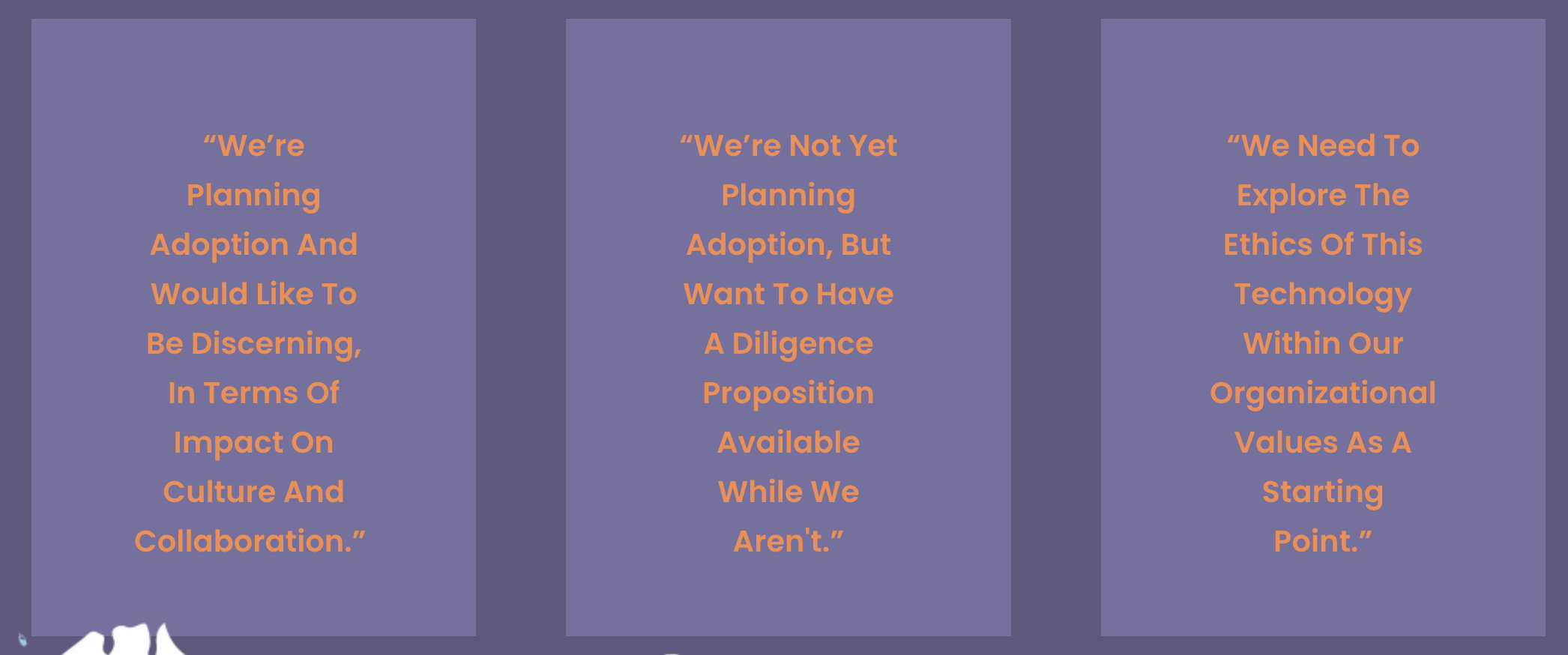
But let’s return to FOMO now. In the conversations we tend to have, in the kinds of organizations we are trying to support, we are actually hearing a lot of fear that I could call Fear Of Selling Out, more than fear of missing out. This is a fear of adopting dangerous technology that is hyped for profit at the expense of the environment, through exploitative labour, reinforcing and amplifying the bias and power imbalances we’ve been working so hard to unsettle. There’s also a fear of being sold out, of seeing our job or our colleagues’ jobs lost to automation during a cost of living crisis. These are existential fears. Unaddressed, they create tension, mistrust, disengagement…sometimes loudly, sometimes stealthily. Facilitated discussion is usually a great start here, and can sometimes lead to valuable insights into possible work design, ethical or reputational safeguards, or learning and developmental plans. Ideally it creates the space for you and your team to discern, together, what’s right for your mission, for your purpose.
If any of this sounded familiar to you, or perhaps you’d like to ensure that it doesn’t end up sounding familiar, consider booking a (free) chat with us from this nook of our website: